
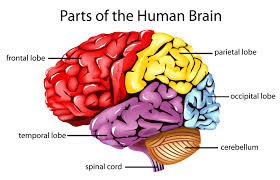
Anatomy of the Human Brain
The human brain is a remarkably intricate organ, composed of various regions and structures that work synergistically to facilitate cognition, motor function, and emotional regulation. Central to its function are the three primary parts: the cerebrum, cerebellum, and brainstem, each serving a distinct role within the overall architecture of the brain.
The cerebrum, the largest part of the brain, is divided into two hemispheres and is responsible for higher cognitive functions. It houses four main lobes: the frontal, temporal, parietal, and occipital lobes. The frontal lobe is critical for decision-making, problem-solving, and controlling voluntary movements; it is often associated with personality and emotional expression. The parietal lobe plays a vital role in processing sensory information, managing spatial orientation and navigation. Meanwhile, the temporal lobe is engaged in auditory processing and memory, providing a foundation for language comprehension.
The occipital lobe, located at the back of the brain, is primarily responsible for visual perception, interpreting information received through the eyes. Together, these lobes orchestrate complex tasks, enabling individuals to interact with their environment meaningfully.
Below the cerebrum lies the cerebellum, often referred to as the “little brain,” which is critical for coordination and balance. It fine-tunes motor activities and is essential for learning physical skills. The brainstem connects the brain to the spinal cord and regulates vital functions, such as heart rate, breathing, and consciousness. This structure serves as a vital communication pathway between the brain and the body, allowing for efficient transmission of sensory and motor signals.
In summary, the various regions of the brain, including the cerebrum, cerebellum, and brainstem, collectively contribute to the diverse capabilities of human beings. Understanding the anatomy of the human brain is essential to appreciating its unparalleled complexity and functionality.
The Functions of the Human Brain
The human brain is a complex organ that performs a myriad of functions essential for both survival and the richness of human experience. At its most basic level, the brain regulates vital bodily functions such as respiration, heartbeat, and the basic maintenance of homeostasis. These processes are primarily managed by the brainstem and other subcortical structures that operate largely below the level of conscious awareness. For instance, the medulla oblongata, located at the base of the brain, controls autonomic functions that are critical for life, including blood pressure and breathing rate.
Beyond these basic survival mechanisms, the human brain is responsible for higher-level cognitive processes. The cerebral cortex, particularly the regions associated with higher functions, plays a crucial role in activities such as thinking, reasoning, and decision-making. This part of the brain enables individuals to assess situations, solve complex problems, and even engage in abstract thinking. In addition, the prefrontal cortex is particularly noteworthy for its involvement in planning and social behavior, allowing for the complex interactions characteristic of human society.
Another remarkable aspect of brain function lies in creativity and emotional processing. The limbic system, which includes structures like the amygdala and the hippocampus, is fundamental in regulating emotions and forming memories. This emotional intelligence is essential for nurturing relationships and navigating social environments. The interplay between various regions of the brain facilitates a symphony of functions that govern both instinctual responses and learned behaviors.
Ultimately, the remarkable capabilities of the human brain illustrate not only its biological significance but also its role in shaping the essence of who we are as individuals within a social landscape. The seamless interaction between basic and advanced functions illustrates the brain’s unique ability to adapt and respond to ever-changing environments, solidifying its central position in understanding human behavior.
The Unique Features of the Human Brain
The human brain, while similar in structure to those of other animals, exhibits several distinct features that underscore its uniqueness. One notable characteristic is its size in proportion to body mass. The human brain weighs approximately 1.4 kilograms and constitutes about 2% of a person’s body weight, which is significant when compared to other species. For instance, the brain-to-body mass ratio is particularly high in humans, as this enables advanced cognitive functions that are not as developed in other animals.
Another striking aspect of the human brain is its intricate network of neural connections. With an estimated 86 billion neurons and trillions of synapses, this complex web facilitates advanced cognitive processing, memory retention, and problem-solving abilities. The raw processing power and connectivity of the human brain surpass those of other species, which can be linked to more sophisticated behaviors and social structures.
Additionally, humans possess unique cognitive abilities that manifest in conscious thought, language, and social interaction. The capacity for abstract reasoning and complex vocabulary allows for nuanced expression of ideas and emotions. This linguistic capability is critical for fostering relationships and facilitating cooperation within social groups. The development of culture and societal norms is greatly influenced by our ability to communicate, setting humans apart from other animals.
The evolution of the human brain remains an area of active research, with theories suggesting that selective pressures, such as the need for social cohesion and problem-solving in novel environments, have shaped our cognitive evolution. These exceptional features of the human brain not only define our species but also contribute to the rich tapestry of human experience, marking our place in the animal kingdom as uniquely gifted beings capable of profound thought and creativity.
Challenges in Understanding the Human Brain
Despite significant advances in neuroscience, understanding the complexities of the human brain remains one of the greatest scientific challenges. The brain, with its approximately 86 billion neurons, operates through intricate neural networks that work in concert to facilitate myriad functions, from regulating basic physiological processes to enabling complex thoughts and emotions. One of the primary obstacles neuroscientists face is the sheer complexity of these neural connections, often described as one of biology’s most convoluted puzzles. The dynamic nature of these networks, influenced by factors such as environment and experience, adds an additional layer of difficulty in discerning how specific structures relate to particular functions.
Another challenge lies in the phenomenon of brain plasticity, which refers to the brain’s ability to reorganize itself by forming new neural connections throughout life. While plasticity is a vital aspect of learning and recovery from brain injuries, it complicates efforts to map functions to specific brain regions consistently. This adaptability can lead to variability in individual responses to similar stimuli, obscuring researchers’ ability to establish a one-size-fits-all understanding of brain function.
Moreover, ethical considerations surrounding invasive research methods pose restrictions on how far scientists can go in studying live human brains. This limitation emphasizes the importance of non-invasive techniques, such as functional MRI and advanced imaging modalities, yet these methods come with their limitations in terms of resolution and interpretive complexity. Ongoing research is crucial in addressing these gaps in our knowledge. Innovative technologies and interdisciplinary collaborations promise to bridge existing knowledge divides, offering hope for deeper insights into brain function and structure. As neuroscience continues to evolve, the pursuit of understanding the human brain remains a captivating journey imbued with potential breakthroughs that could transform our perception of humanity itself.